ESG commitment
Our ESG framework ensures commercial success and positive impact are inseparable
ESG compliance is the foundational framework upon which our entire business model is constructed — integrating environmental stewardship, social responsibility, and ethical governance across all facets of our operations.
Environmental stewardship
Deployment of solar-powered agricultural technologies, promotion of sustainable land use, green logistics, and active mitigation of environmental impacts across our supply chains.
Social responsibility
Empowerment of smallholder farmers, fair labour standards, and a steadfast commitment to Gender Equality (SDG 5) — ensuring women in agricultural communities have equal access to resources, training, and trade opportunities.
Governance & compliance
Full adherence to UK corporate governance standards, transparent reporting, rigorous due diligence, and alignment with international ESG benchmarks including Fair Trade.
UN Sustainable Development Goals
Aligned to seven global goals
Certifications
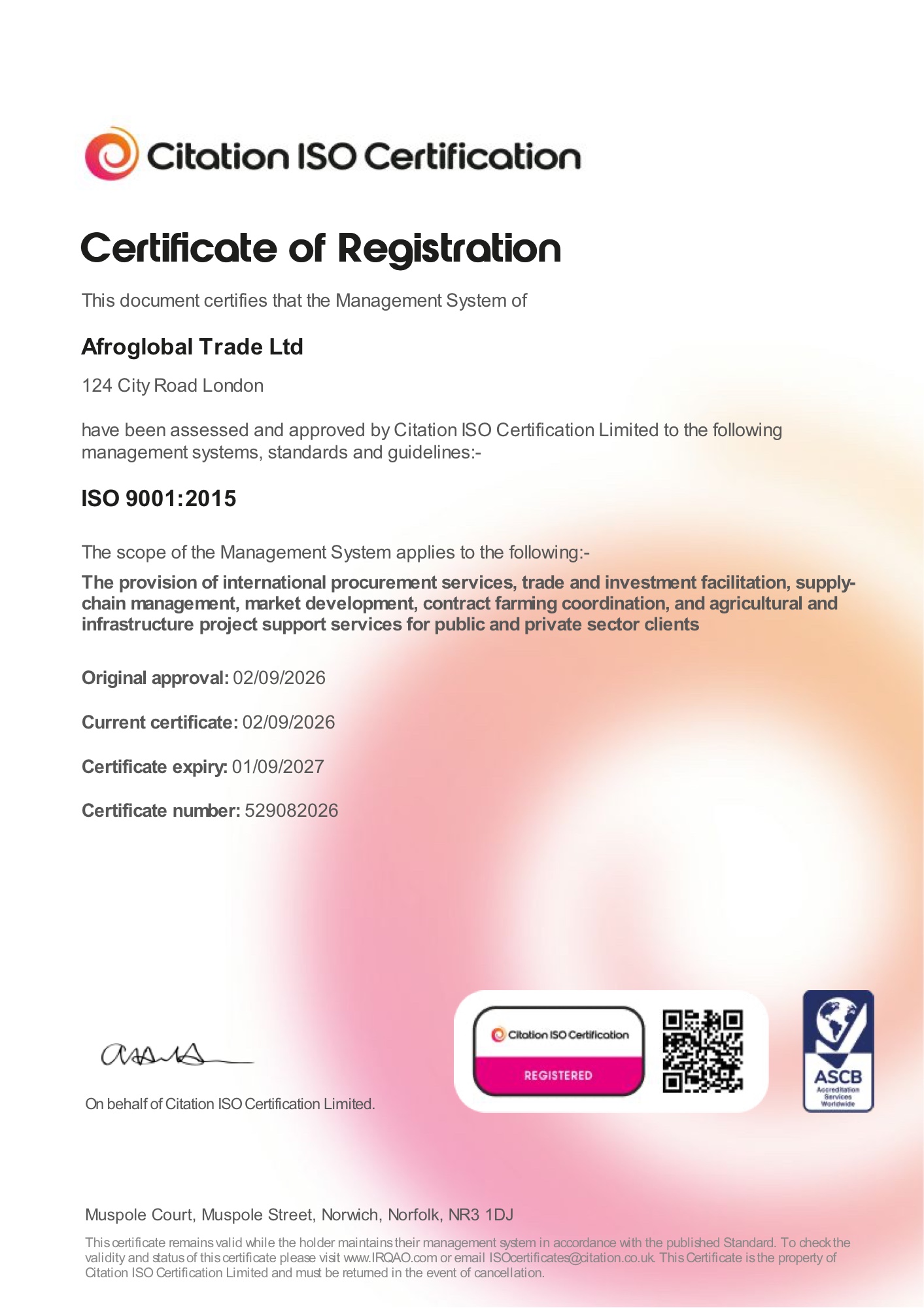
ISO 9001:2015 certified quality management
Our management system has been independently assessed and approved by Citation ISO Certification Limited to ISO 9001:2015 — the international standard for quality management — confirming that the way we source, contract, and deliver is documented, audited, and continually improved.
- Standard
- ISO 9001:2015
- Certificate number
- 529082026
- Certification body
- Citation ISO Certification Ltd
- Accreditation
- ASCB (Accreditation Services Worldwide)
- Issued
- 2 September 2026
- Valid until
- 1 September 2027
Contract farming
Unlocking Sub-Saharan Africa's 202 million hectares of arable potential through structured partnership
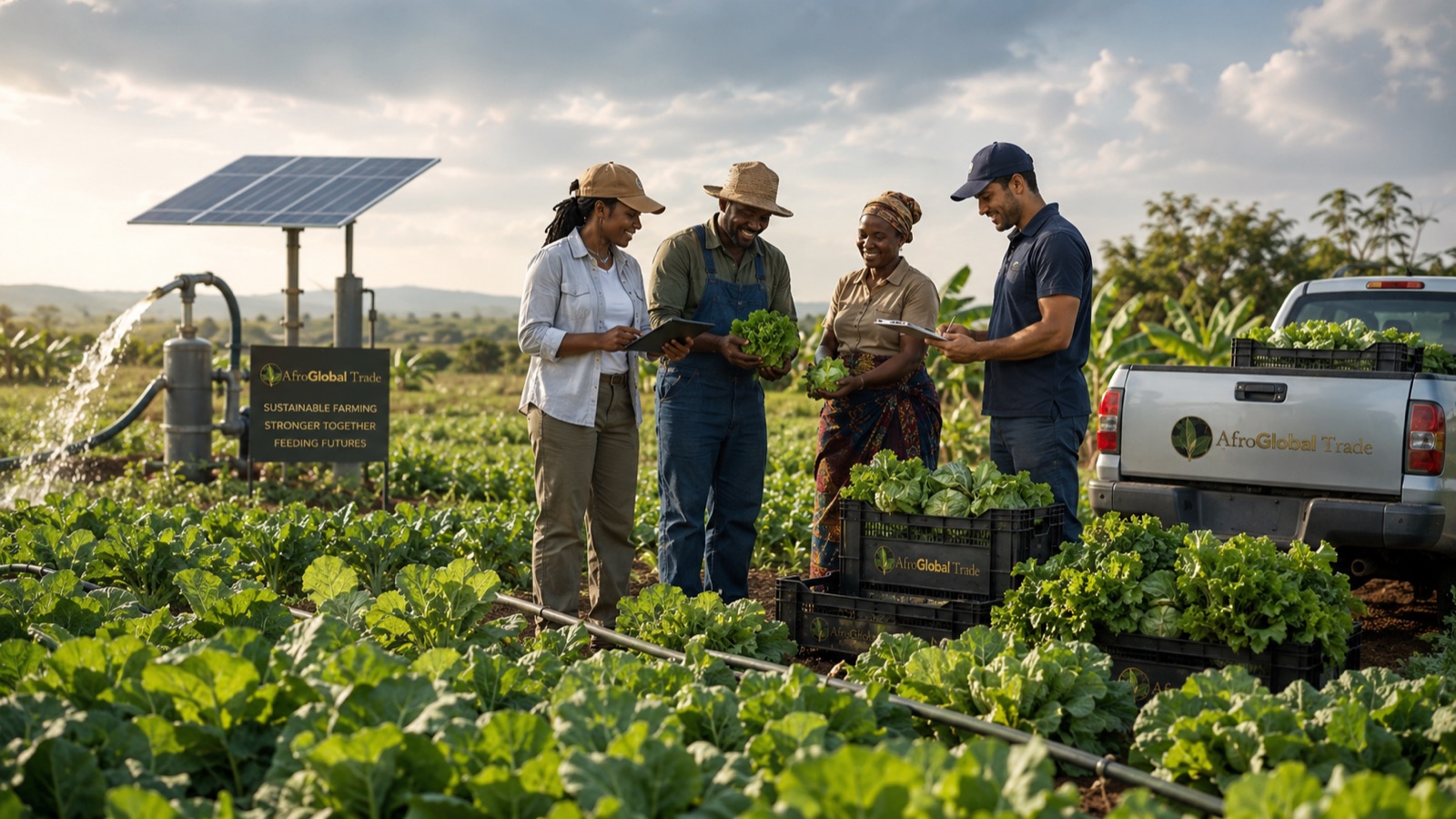
Our contract farming programme represents one of the most impactful dimensions of Afroglobal Trade's operations. By forging structured agreements with smallholder farmers across Sub-Saharan Africa, we integrate local producers into the global agricultural value chain — providing them with access to quality inputs, advanced agronomic guidance, and guaranteed market offtake.
The World Bank has identified approximately 202 million hectares of non-forested, cultivable land across Sub-Saharan Africa — a resource of extraordinary global significance. Afroglobal Trade is actively engaged in harnessing this potential in a manner that is environmentally responsible, socially inclusive, and commercially viable.
Programme highlights
- ✓ Alignment with SDG 2 (Zero Hunger) and SDG 15 (Life on Land)
- ✓ Provision of quality agricultural inputs and technical support to participating farmers
- ✓ Guaranteed offtake agreements providing income stability for smallholder producers
- ✓ ESG-compliant operations covering gender equality, responsible production, and climate action
- ✓ Research-backed model: IFPRI studies confirm efficacy in enhancing rural incomes and reducing poverty
Field story · Malawi
The warm heart of Africa, prepared for the world
Malawi already knows what it wants to export. Our role is the unglamorous work in between — getting the crop ready to meet the standard the buyer demands.
Malawi is a nation of smallholders. More than four in five of its people farm, most on a hectare or two, and the rhythm of the country follows the rains — from November planting to the tea flush in the Thyolo and Mulanje hills, the macadamia harvest in the centre and north, and the groundnut and pigeon-pea harvests of April and May. Malawi is among the world's largest tea exporters and a top-ten exporter of macadamia — and Malawian macadamia is hand-picked, which is why buyers prize it.
The country's export ambition is set out clearly in its National Export Strategy, and delivered by the Malawi Investment and Trade Centre (MITC) — the single-window authority under the Investment and Trade Act 2024 that registers exporters, identifies markets, publishes what those markets demand, and guides producers on standards, certification, packaging and branding. That framework is the foundation we work within, not around.
What the strategy also states plainly is that too much of Malawi's harvest still leaves the country as raw commodity, and that a large share of its export potential goes unrealised. The International Trade Centre's assessment names the reasons: groundnuts that cannot yet be reliably tested and graded for aflatoxin, so the premium European markets stay closed; macadamia whose value depends on mastering a long, careful drying before the kernel is extracted; tea shipped almost entirely in bulk; pulses that could be graded, frozen or milled but mostly are not.
Those gaps sit between the farm gate and the export gate — and that is precisely where our Lilongwe branch is building its market entry. Working alongside cooperatives, aggregators and MITC's export-development programmes, we concentrate on export preparation: post-harvest drying and storage that limits aflatoxin, moisture testing and grading to buyer specification, sorting and shelling, export-grade packing, and the documentation that gives a consignment a traceable chain of custody. Then we connect that export-ready product to the buyers we already serve in Europe, the Middle East and Asia.
This is deliberately complementary. MITC opens the door and sets the standard; Malawi's growers produce the crop; we do the value-addition that lets the crop walk through that door at the price it deserves — and ensure the premium reaches the producer. Every consignment we prepare is registered and documented through the proper national channels.
Malawi's farmers have always been able to grow. The missing step has been preparation — turning a good harvest into an export-grade, traceable product. Building that capacity, one cooperative and one graded consignment at a time, in step with the national strategy, is what we are here to do.
Sources: Malawi National Export Strategy II (2021–2026); Malawi Investment and Trade Centre; International Trade Centre, Exploring Malawi's Export Potential (2018).
Catalysing enduring global partnerships for a sustainable and equitable future.
Afroglobal Trade LTD